

 English
 Español
 عربى
We are a national high-tech enterprise. At present, there are many kinds of self-woven and cooperatively processed fabrics, including microfiber warp-knitted towel cloth, weft-knitted towel cloth, coral fleece, etc.
Content
- 1 What Custom Actually Covers
- 2 Which Fleece Should You Actually Choose?
- 3 Printing: Turning Artwork into a Repeatable Result
- 4 Edge Finishes: The Detail That Decides How a Blanket Ages
- 5 Size, Weight and Hand Feel
- 6 How a Bulk Custom Fleece Blanket Order Runs
- 7 Quality Questions Worth Asking Any Supplier
- 8 Matching the Blanket to the End Use
- 9 Frequently Asked Questions
- 9.1 What is the minimum order for a custom fleece blanket?
- 9.2 Can you print photographs on fleece?
- 9.3 Which fleece is warmest?
- 9.4 How long does production take?
- 9.5 Can we use our own labels, hangtags and packaging?
- 9.6 Are custom fleece blankets machine washable?
- 9.7 Can you make a blanket in a size that is not on your list?
Ask five buyers what a custom fleece blanket is and you will get five different answers. For one it is a photo-printed throw sold through an online listing. For another it is a heavier coral fleece blanket with a folded edge, a woven label and a printed belly band, folded eight to a carton for a supermarket promotion. For a third it is simply a size that does not exist in any standard catalogue, or a colour that has to sit exactly beside a brand guide.
All of them are right, and that is precisely why blanket sourcing so often goes sideways. Custom is not one decision. It is a small stack of decisions about material, print, size, finish and packing, and each one adds cost, lead time and risk to a different part of the process.
We are Shaoxing DingYi Textile Co., Ltd., a mill and finished-goods factory based in Shaoxing, Zhejiang, in the China Textile City area. We knit, print, cut and sew pile fabrics such as flannel, coral fleece and polar fleece, and we turn them into blankets, bedding, duvets and loungewear that ship to supermarkets and cross-border brands around the world. Because the fabric and the finished blanket are made under the same roof, we tend to see the whole chain of decisions rather than only one end of it.
This guide walks through that chain: which fleece to choose, how printing actually behaves on a brushed surface, what edge finishes do over a few years of washing, how to specify a size you can inspect against, and what to ask before a bulk order is confirmed.
What Custom Actually Covers
The word gets used loosely, and that looseness is where most sourcing problems begin. It helps to sort the decisions into two piles: the ones that belong to the buyer, and the ones that belong to the mill.
Decisions that belong to the buyer
- Artwork and design direction: all-over print, placement, border or panel.
- Colour targets, given as a Pantone reference or a physical swatch.
- Finished size, plus the tolerance you are willing to accept.
- Material family and target weight, quoted in GSM.
- Edge finish, stitch style and thread colour.
- Branding: woven label, care label, hangtag, belly band.
- Retail packaging, folding method and carton marks.
Decisions that belong to the mill
- Knit structure and pile height for the chosen fabric.
- Colour recipe and the dyeing or printing sequence behind it.
- Ink or dye system, and the curing window that fixes it.
- Shrinkage allowance built into the cut size.
- Stitch density, seam construction and edge reinforcement.
- In-line checkpoints and final inspection criteria.
- How the batch is traceable back to the approved sample.
In practice the two piles overlap far more than buyers expect. A request for a thicker blanket is a buyer's wish, but whether that thickness comes from a heavier knit, a taller pile or a second layer of fabric is a mill decision with very different cost and hand-feel consequences. Colour works the same way. The buyer owns the target; the mill owns the recipe that reaches it on a pile surface, where light scatters and a shade can read two steps lighter than it does on a flat swatch.
A well-written specification names a number for every attribute that matters, and a tolerance for every number. That single document prevents more disputes than any amount of goodwill afterwards.
Which Fleece Should You Actually Choose?
Fleece is a family, not a single fabric. The pile you pick sets the hand feel, the print result, the price band and the wash behaviour of the finished blanket, so it is worth choosing deliberately rather than defaulting to whatever the last order happened to use.
| Material | Surface character | Relative weight | Common use |
|---|---|---|---|
| Flannel fleece | Brushed, short and dense pile with a soft matte face | Light to mid | Printed throws, seasonal bedding, retail promotions |
| Coral fleece | Curly, textured surface that traps air well | Mid | Warm throws, fitted sheets, robes |
| Polar fleece | Lofty napped pile, resilient and quick to dry | Mid to heavy | Outdoor-style blankets, corporate gifting |
| Double-sided fleece | Plush pile on both faces | Mid to heavy | Premium throws, double-layer blankets |
| Rabbit fur fleece | Long, silky pile with a soft sheen | Mid | Decorative throws, cushions |
| Imitation cotton velvet | Smooth, cotton-like handle rather than a visible pile | Light to mid | Blankets where a calmer surface is wanted |
| Ultra-soft fleece | Fine denier, silky and drapey | Light to mid | Baby ranges, gifting, photo blankets |
A useful rule of thumb: the taller and looser the pile, the more a print softens and blurs into the surface. Fine, dense piles hold detail; long, open piles flatter large blocks of colour but lose thin lines and small text. If your artwork contains fine type, ask for a proof on the exact pile you intend to buy rather than on a smooth sample.
Weight is the number buyers ask about most and understand least. GSM describes mass per square metre, but two fabrics at the same GSM can feel completely different if pile height, yarn denier or knit density differ. A sample in your hand, at the specification you intend to order, is worth more than any figure in a quotation.
Our own range covers every material in the table above, supplied either as greige fabric for further processing or as a finished blanket. If you are unsure which pile suits your market, send the artwork and the target price point and ask for two or three options rather than one.
Printing: Turning Artwork into a Repeatable Result
Printing is where a design that looked perfect on a screen meets the realities of ink, fibre and heat. The variables are manageable, but only when they are settled in the right order.
All-over print
The design repeats across the full width of the fabric. Best for patterns and large graphic fields. The detail that decides quality is repeat matching, so that any seam or fold falls in a place where the eye does not catch it.
Placement print
A single image or logo sits in a fixed position on each blanket. Position tolerance matters here and should be agreed in millimetres, because a logo two centimetres off centre is the first thing a retail buyer notices.
Border and panel print
Printing is confined to a band or panel, leaving the centre plain. A popular choice for gift and promotional blankets, where a message or a date carries more weight than a full pattern.
Repeat and scale
The size of a motif relative to the blanket decides whether the print reads as a texture or as an image. Scaling artwork up is not the same as enlarging it; it usually means redrawing the repeat.
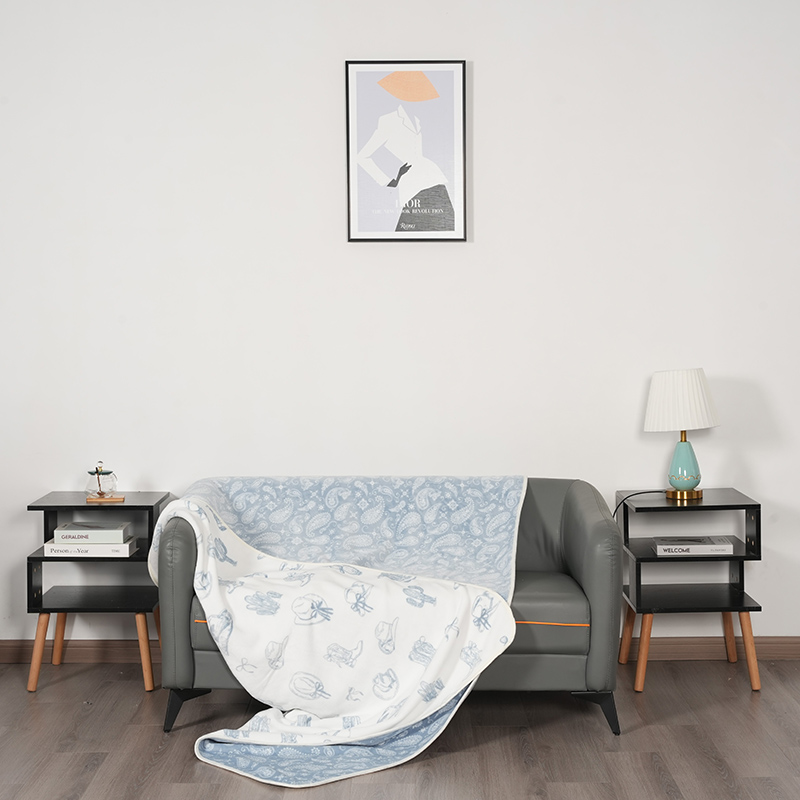 Printed Flannel Fabric with Warm Fleece and BreathabilityA printed flannel with dense fleece warmth, moisture absorption, and breathability; useful when reviewing motif scale and print approval before bulk production.View Product →
Whichever format you choose, the approval chain is short and worth taking seriously: a strike-off or trial print on the production fabric, checked against your colour reference under agreed lighting, then signed off in writing before the bulk run starts. Skipping that step to save two weeks tends to cost considerably more than two weeks.
1. Artwork intake
Files are checked for resolution, colour separation and repeat size before anything is prepared for the press.
2. Trial print
A strike-off is produced on the actual pile fabric, because ink sits differently on a brushed surface than on a flat one.
3. Colour sign-off
You approve against your reference, and that approved sample becomes the standard for the entire run.
4. Bulk printing
The production run proceeds with in-line checks on registration, coverage and colour continuity across the batch.
5. Curing and finishing
Heat and dwell time are controlled so the print survives washing without stiffening the pile or dulling the surface.
6. Cutting, sewing and inspection
Printed panels become blankets, and each batch is measured and compared against the approved sample before packing.
Edge Finishes: The Detail That Decides How a Blanket Ages
Two blankets can use identical fabric and identical printing and still feel like different products after a year, purely because of the edge. The edge is also the first thing a customer touches when they pick the blanket up in a shop, which makes it a design decision as much as a durability one.
Bound edge
A strip of fabric is folded over the raw edge and stitched down. The result is a firm, well-defined border that resists fraying and keeps its shape through repeated washing. Because the binding can be a contrasting colour or a close match, it doubles as a design element, and it is the finish most often specified for retail blankets.
Folded edge
The fabric itself is turned and stitched, giving a softer, lighter edge with no added material. The look is cleaner and more minimal, and the cost is lower because no binding strip is required. It suits designs where the print should run to the very edge of the blanket.
Double-layer
Two fabric layers are joined, usually with pile facing out on both sides. The blanket becomes warmer and heavier, and the reverse looks as finished as the front. This is the construction to choose when the blanket is meant to be seen from both sides.
If you are weighing the two simpler options, we wrote a closer comparison of the folded edge versus a regular blanket edge that goes through the cost and durability differences in more detail.
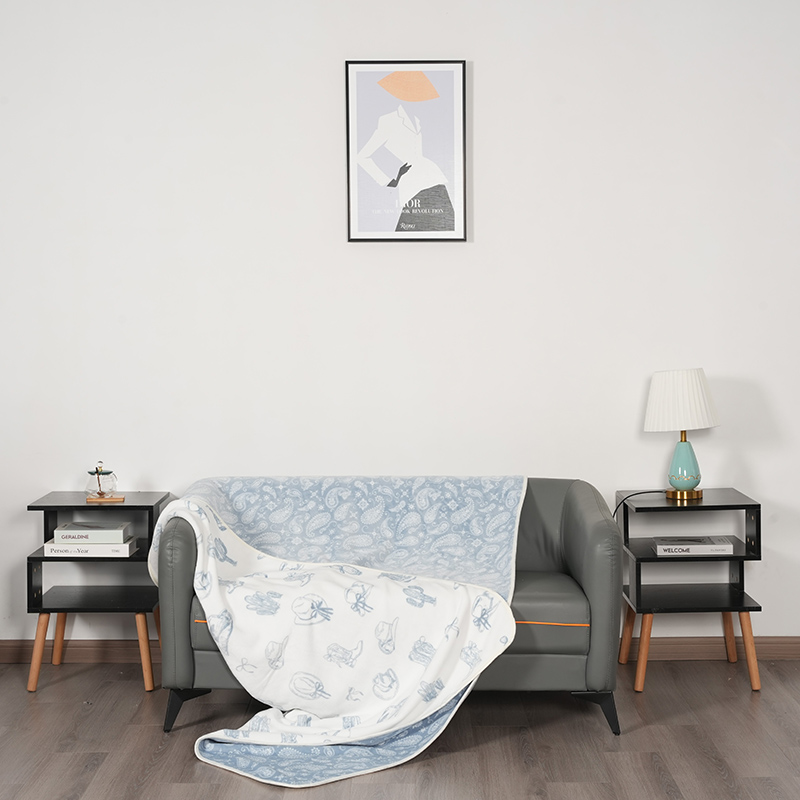 Flannel Bound Edge Blanket for Warm Sleep and RestA flannel bound-edge blanket described for soft warmth in autumn, winter, or daytime rest; useful when specifying edge finish, stitch density, and seam allowance.View Product →
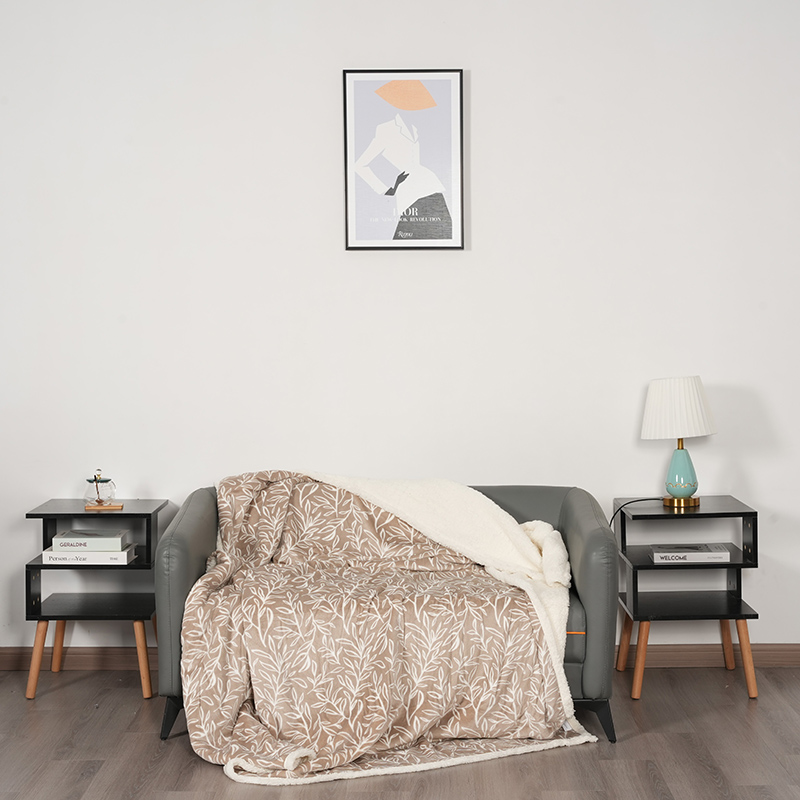 Flannel Double-Layer Blanket for Cold-Weather InsulationA double-layer flannel blanket described as trapping still air for cold-weather warmth while staying relatively lightweight; useful when comparing edge finishes and stitch specifications.View Product →
Whichever finish you settle on, ask for the stitch density and the seam allowance to be written into the specification. A generous stitch count with a slightly larger seam allowance is the cheapest insurance a blanket can carry.
Size, Weight and Hand Feel
Blanket sizing looks like the simplest part of a specification and turns out to be one of the trickiest, because a cut size is not a finished size. Fabric relaxes and shrinks through printing, washing and finishing, so the mill works with an allowance and the number that matters is the measurement taken after finishing.
The bars show relative coverage only. Cut size, shrinkage allowance and finished dimensions are agreed order by order, and the tolerance is written into the specification before cutting begins.
Two things are worth pinning down in writing. The first is finished size with a tolerance; a small percentage either way is a common starting point, and anything tighter needs to be discussed before sampling rather than after inspection. The second is weight, quoted in GSM alongside the pile height, because those two numbers together describe how thick the blanket will actually feel rather than how heavy the carton will be.
Hand feel is the last variable and the hardest to write down. Where possible, ask for a physical sample of the exact construction you intend to buy. Photographs and descriptions carry a surprising amount of information, but not the one that matters most to the end customer: how the blanket feels against a cheek.
How a Bulk Custom Fleece Blanket Order Runs
A blank blanket order rarely fails at the sewing machine. It fails at the handover points, where one party assumes something the other party never confirmed. Here is the sequence we work to, and the point in it where most risk sits.
- Enquiry and specification. Artwork, size, weight, finish, packing and target quantity are exchanged, and open questions are listed rather than guessed at.
- Sampling. Fabric and construction samples are produced so the specification can be confirmed in the hand instead of on paper.
- Print proof. Strike-offs and colour references are approved in writing, with the lighting conditions noted.
- Order confirmation. The approved sample, the specification sheet and the purchase order are aligned so that all three describe the same blanket.
- Fabric production. The pile fabric is knitted, then dyed or printed according to the agreed recipe and finishing route.
- Cutting and sewing. Panels are cut with shrinkage allowance and assembled with the agreed edge finish, labels and trims.
- Inspection and packing. Finished blankets are checked against the approved sample, then folded, bagged and packed to the agreed carton specification.
- Shipping. Cartons are marked as agreed and the consignment is handed to the forwarder with the documentation set.
The step that slips most often is the fourth. When the approved sample, the specification and the purchase order drift apart, even slightly, the discrepancy does not surface until inspection, which is the most expensive possible moment to find it. Treating one document as the single source of truth costs nothing and prevents most of it.
Quality Questions Worth Asking Any Supplier
Every buyer has a mental checklist. These are the questions we think are worth asking in writing, together with the kind of answer that should satisfy you.
What weight did we actually receive?
Weight should be measured against the approved specification and answered with a number plus a tolerance, not with reassurance.
Will it pill after five washes?
Pilling depends on fibre, pile height and finishing. Ask for a wash test carried out on the production fabric, not on a swatch from a different batch.
Is the print fast to rubbing and washing?
Colourfastness results on the printed face and the reverse are the only honest answer, and they matter most for deep blacks, navies and reds.
How much will it shrink?
Shrinkage should be measured after the finishing route actually used in production, not after a laboratory shortcut.
Will the corners hold?
Stitch density, thread type and seam allowance all contribute. A simple pull test on a finished blanket takes minutes and answers the question.
Could a broken needle reach the customer?
Needle detection at the end of the line is standard practice in finished-goods production, and the record should be traceable back to your batch.
Does the carton match the purchase order?
Packing accuracy is part of quality. A perfect blanket in a wrongly labelled carton is a return waiting to happen.
Matching the Blanket to the End Use
The same custom fleece blanket becomes a different product depending on where it is sold. A design that wins on a marketplace listing can look thin on a supermarket shelf, and a construction built for heavy laundering can be an unnecessary cost in a gift set.
Supermarket and mass retail
Price band, folded size and shelf-ready packing drive the decision. Colour consistency across repeat orders matters more than novelty, because the blanket has to look identical on the shelf in six months' time.
Cross-border e-commerce
Photography-friendly designs, individual packaging and dimensional accuracy carry the weight here. A blanket that photographs flat and arrives plump is worth more than one that photographs beautifully and arrives thin.
Promotional and corporate gifting
Print quality and edge finish carry the perceived value, and smaller sizes with a crisp logo often outperform large plain blankets at the same cost.
Hospitality and rental
Colourfastness, industrial wash performance and an edge that survives repeated laundering matter far more than softness on day one.
Pet and baby ranges
Shorter, denser piles, careful inspection and a conservative approach to trims and loose fibres suit these categories better than a decorative high pile.
Licensed design and collaborations
Colour accuracy against brand references and consistency between production runs are the whole product. A second run that drifts half a shade undoes the first.
Blankets rarely ship alone. If a program includes bed linen, matching a printed throw with coordinating bedding sets keeps the colour story consistent across the range, and the same base fabric can often serve both products, which simplifies both sampling and repeat orders.
Frequently Asked Questions
What is the minimum order for a custom fleece blanket?
It depends on the print method, the fabric and the packing. Short runs are workable with some printing routes and not with others, and the honest answer changes with the artwork. Send the design and the quantity you have in mind and we will tell you plainly whether it is realistic.
Can you print photographs on fleece?
Yes, and the real question is how much fine detail the pile will hold. Dense, short piles keep more detail than long, open ones. For photo blankets we usually recommend a proof on the intended fabric before the order is confirmed.
Which fleece is warmest?
Warmth comes from trapped air, so a taller, looser pile such as coral fleece, or a double-layer construction, usually feels warmer than a dense brushed flannel at the same weight. For very cold markets, a double-layer blanket with pile on both faces is often a better answer than simply adding weight.
How long does production take?
Lead time is driven by sampling, print preparation and the finishing route rather than by sewing. Once the sample and the print are approved, the run itself is generally the fastest part of the schedule. Ask for a dated schedule with the quotation so you can plan around real milestones.
Yes. Woven labels, care labels, hangtags, belly bands and printed cartons are all part of a finished-goods programme, and they need to be specified early, because packing decisions affect carton dimensions, the fold and sometimes the blanket size itself.
Are custom fleece blankets machine washable?
Pile fabrics are generally washable, and the care label should describe the construction you actually bought rather than a generic instruction. If a blanket is intended for industrial laundering, say so at the sampling stage, because the finishing route changes accordingly.
Can you make a blanket in a size that is not on your list?
Yes. Sizes are cut from fabric, so a new size is a specification question rather than a tooling question. What matters is agreeing the cut size, the shrinkage allowance and the finished tolerance before anything is cut.
If your question is not on this list, ask it anyway. Most of the useful conversations we have with buyers start with a specification that does not exist yet and end with a blanket that does.