

 English
 Español
 عربى
We are a national high-tech enterprise. At present, there are many kinds of self-woven and cooperatively processed fabrics, including microfiber warp-knitted towel cloth, weft-knitted towel cloth, coral fleece, etc.
Content
- 1 What Counts as Personalized, and for Whom
- 2 The Fabric Layer: Which Fleece Takes Decoration Best
- 3 Five Decoration Routes That Survive Real Use
- 4 Sizes, Formats and What Each One Is For
- 5 Edge Finishing: The Detail Buyers Notice Last, Then Always
- 6 From Artwork to Bulk: How a Personalized Program Moves
- 7 Before the First Sample: Questions Buyers Ask Us
- 8 Quality Checks and Care That Protect the Personalization
- 9 Frequently Asked Questions
- 9.1 What is the best fabric for a personalized sherpa blanket?
- 9.2 Which size sells best as a gift?
- 9.3 Can you produce one sample before a bulk order?
- 9.4 How should a personalized fleece blanket be washed?
- 9.5 Do custom blankets have to be printed on both sides?
- 9.6 Who do you usually supply these programs to?
Somewhere between a baby shower in Ohio and a corporate gifting order in Rotterdam, a plain fleece throw becomes something people keep for years. That shift — a photograph, a name, a wedding date, a club crest — is what most people mean when they type "personalized sherpa blanket" into a search bar. We have been on the manufacturing side of that shift for a long time, and the questions have changed. Buyers rarely ask whether a blanket can be personalized anymore. They ask how soft it stays after ten washes, how the edges hold up, how the print sits on a curly pile, and how quickly a sample can be in their hands.
We are Shaoxing DingYi Textile, a blanket and fabric mill based in China Textile City, Keqiao, Zhejiang. Flannel, coral fleece, sherpa and polar fleece all run through the same building, from greige fabric to finished, folded, bagged blanket. That is why a customization request with us usually starts as a conversation about cloth rather than about artwork — and why this guide starts there too.
Fabric first
Print sharpness, pile height and wash life are decided before the artwork is ever approved.
Details carry the price
Binding, labels, hangtags and polybags often explain a bigger share of the unit cost than the print itself.
Built for repeat programs
Supermarket lines and cross-border brands reorder the same construction season after season.
What Counts as Personalized, and for Whom
The word "personalized" travels in two very different directions in this trade. For a consumer, it usually means one blanket carrying one piece of information: a newborn's name and weight, a photo of a couple, a pet portrait, a university logo, a joke printed in a friend's handwriting. The order quantity is one, the emotional value is high, and the buyer cares most about softness, colour accuracy and whether the gift arrives before the birthday.
For a wholesale buyer, personalization means a repeatable program. A retailer may want a "create your own" station in stores, an online configurator backed by a factory, or a seasonal line where twelve stock designs sit alongside an option for a monogrammed name. The order quantity is in the hundreds or thousands, and the buyer cares about consistency between batches, packing that survives a courier network, and a supplier who can hold a delivery date.
Both routes end up at the same place: a fleece blanket with something added that was not there before. What differs is how much control the buyer has over the recipe, and how much of the specification needs to be locked down in writing.
The Fabric Layer: Which Fleece Takes Decoration Best
Almost every disappointing personalized blanket we have been asked to look at failed at the fabric stage, not the printing stage. A photo printed onto a deep, curly pile loses detail because the pile casts its own tiny shadows. A dense embroidery on a very lofty sherpa can pull the surface into a dimple. None of that is the decorator's fault; the cloth simply was not matched to the technique.
| Fleece family | Hand-feel | Best decoration route | Typical weight | Watch-outs |
|---|---|---|---|---|
| Sherpa (lamb fleece) | Lofty, curly pile, airy | Appliqué, embroidered patch, bonded panel | 220–320 gsm | Pile traps lint; dense direct print sits poorly on the curl |
| Flannel, brushed both sides | Smooth, dense, soft | Photo sublimation, screen print | 180–260 gsm | Brushing depth changes print sharpness between lots |
| Coral fleece | Fine, velvety, feather-light | Sublimation on lighter grounds, embroidery | 180–240 gsm | Short pile can pill if yarn quality is not controlled |
| Polar fleece | Denser, more structured | Screen print, heat transfer, embroidery | 200–300 gsm | Less drape, so the blanket feels heavier on the sofa |
| Double-layer (flannel face + sherpa back) | Sharp printed face, warm curly back | Full-colour photo on the face, plain reverse | 380–520 gsm | Bonding quality decides how the blanket survives washing |
The double-layer construction deserves its own paragraph, because it solves the single hardest problem in this category: how to get a crisp photographic image onto a blanket that still feels like sherpa. Instead of fighting the pile, we print on a smooth brushed flannel face and bond it to a sherpa reverse. The gift looks photographic on one side and feels like a lamb fleece on the other, which is exactly what most gift buyers are trying to describe when they send reference photos.
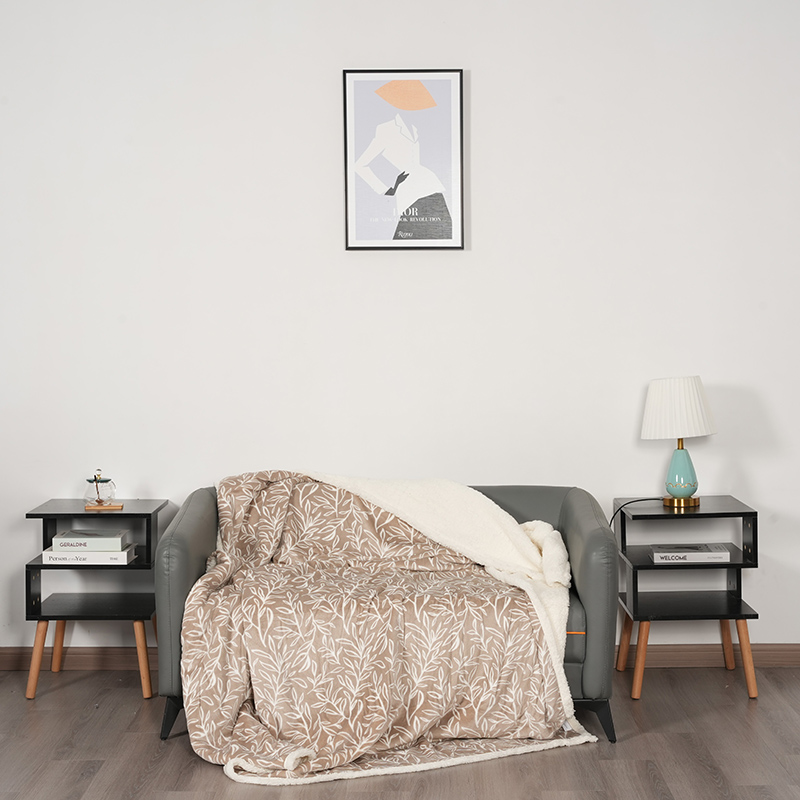 Flannel Double-Layer Blanket for Photographic Gift ProgramsDouble-layer flannel fleece traps still air for warmth while remaining lightweight; a smooth printed face and sherpa reverse suit gift-market sampling.View Product →
If the program is aimed at the gift market rather than at bedlinen sets, this is usually the construction we recommend sampling first.
Five Decoration Routes That Survive Real Use
Every decoration method has a lifespan, and the honest conversation with a buyer is about where that lifespan ends. A blanket that is folded on a guest bed will outlast one that goes to football practice every weekend. Here are the five routes we run most often, in the order buyers tend to ask about them.
1. Photo sublimation
Dye is turned to gas and driven into polyester fibres, so there is no raised layer to crack. Colour is rich and detail is high on a smooth face. It works best on light grounds and on flannel or coral fleece rather than on deep sherpa pile.
2. Embroidery
A name, a date or a three-letter monogram stitched in a corner reads as premium without covering the blanket. On lofty sherpa, ask for a stabilised backing so the stitches do not tunnel into the pile.
3. Screen print and transfer
The practical choice for one-colour logos at volume, and for club crests where a photographic finish is not needed. Cure temperature and pressure matter more than most buyers expect; both should be recorded on the sample sheet.
4. Appliqué and badges
A stitched-on patch or woven badge sits happily on curly pile because it does not need a smooth surface to bond to. It also lets a buyer mix a stock blanket with a seasonal badge and skip a full custom run.
5. Labels, binding and packaging
Often the cheapest way to look custom. A contrast binding, a woven flag label, a printed care label and a printed gift sleeve turn a stock throw into a branded product without touching the fabric surface at all.
Mixing routes
Most commercial programs combine two: a sublimated photo face with an embroidered name, or a screen-printed logo with a woven badge on the corner. Two routes add cost, but they also add a reason to charge more.
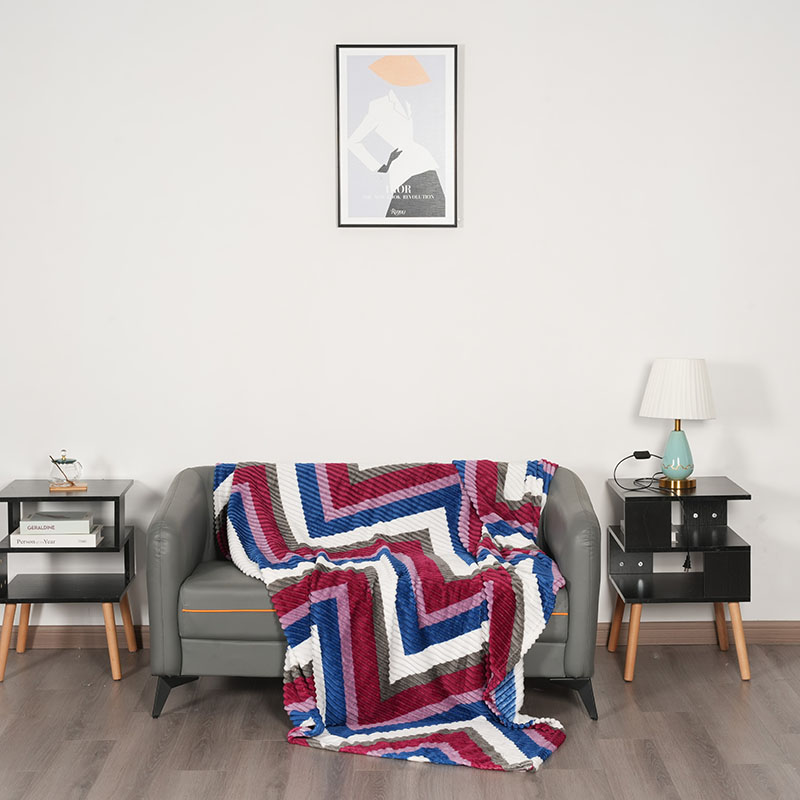 Printed Ultra Soft Fabric for Apparel and Home FurnishingsPrinted ultra-soft fabric combines floral or geometric prints with breathable, skin-friendly softness and lint-free treatment for apparel and home furnishing projects.View Product →
Sizes, Formats and What Each One Is For
Size is the quiet specification. A 30 × 40 inch blanket is a pet or pram throw; a 50 × 60 inch is the classic gift throw; 60 × 80 inch reads as a bed topper; 90 × 90 inch is the oversized sofa blanket people fight over in winter. Get the size wrong for the channel and the softness will not save the program.
Bar lengths show relative demand we see across gift and retail programs. They are indicative, rounded, and not audited figures.
A second format question sits underneath size: does the personalization go on one side or both? A single printed face bonded to a plain sherpa reverse is the most common answer. A blanket printed on both faces costs more in fabric and in handling, and it is usually only worth it when the reverse will be visible — folded in a gift box, draped over a chair back, or used as a wall piece in a nursery.
Edge Finishing: The Detail Buyers Notice Last, Then Always
An unfinished or badly finished edge is the first thing a laundry test reveals. There are two mainstream answers. A bound edge wraps the blanket perimeter in a separate binding tape and stitches it through, which gives a firm, tailored, almost upholstered look and hides a great deal of cut irregularity. A folded edge turns the blanket's own face fabric back on itself and stitches it flat, which looks softer and more continuous because there is no contrasting tape.
The trade-off is real: binding adds a material cost and a step, but it forgives a lot. Folding keeps the silhouette clean and saves the tape, but it demands more accurate cutting and a fabric that behaves. For a personalized blanket that will be washed often, binding is usually the safer recommendation, especially on heavier double-layer constructions where the two plies must be locked together at the perimeter.
We wrote a longer comparison of the two constructions, including where the cost actually lands, in our note on folded edge versus regular blanket finishing.
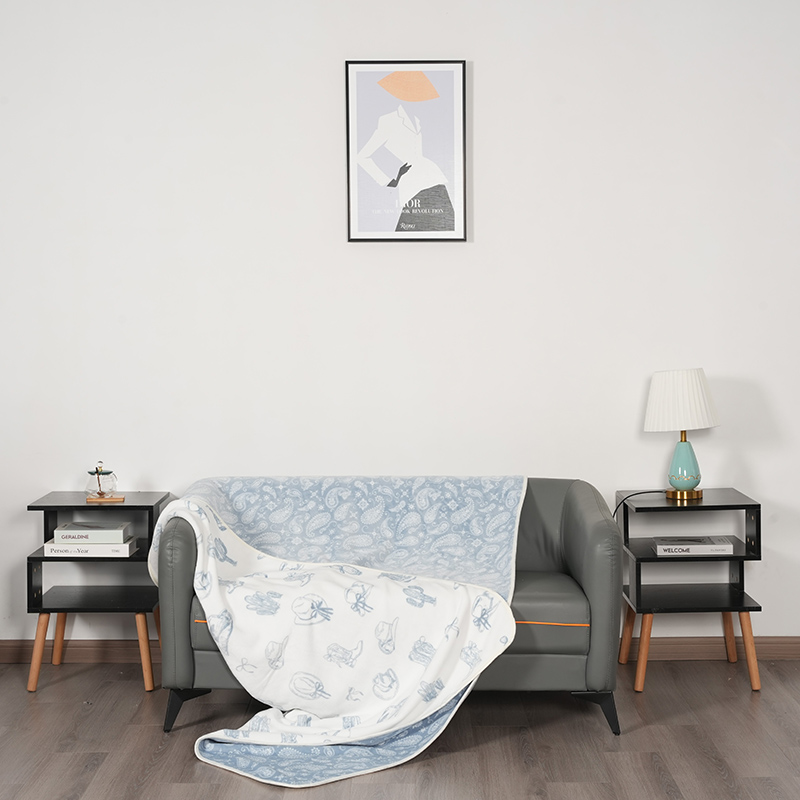 Bound Edge Blankets in Flannel and Polar FleeceCategory covering bound-edge flannel and polar fleece blankets with reinforced finished edges for bedding, throws, infant use, outdoor warmth and gifts.View Product →
From Artwork to Bulk: How a Personalized Program Moves
Timelines vary with the decoration route, but the sequence rarely does. This is the path a custom blanket order normally takes through our floor.
Step 1 — Brief and artwork check
We confirm size, fabric family, weight, decoration route, packing and target quantity. Artwork is checked for resolution at final print size, and colour is discussed honestly: screen colours and dyed polyester will never match perfectly.
Step 2 — Fabric selection and approval
Pile height, brushing depth and hand-feel are settled on a physical swatch. This is the moment to change your mind, not after the print is approved.
Step 3 — Strike-off or sample blanket
Print strike-offs show colour on the actual ground fabric. A full sample blanket then shows the construction, the edge finish, the label placement and the packed weight in the hand.
Step 4 — Bulk fabric and decoration
Fabric is produced and finished, then printed or embroidered. Batch records keep the same lot of fabric with the same decoration run so colour stays consistent across a program.
Step 5 — Cut, sew and finish
Cutting, edge finishing, label attachment and trimming happen in line. Inspection sits between sewing and packing rather than at the very end, so problems are caught while they can still be corrected.
Step 6 — Packing and dispatch
Polybag, ribbon, gift sleeve or retail carton, then carton marking and loading. Packing is specified early because it changes carton dimensions, which changes freight.
Before the First Sample: Questions Buyers Ask Us
Can a photo go directly onto sherpa pile?
It can be done, but detail drops. We usually suggest a smooth printed face bonded to a sherpa reverse instead, which keeps the photographic look and the warm hand-feel in one product.
How many colours can a print carry?
Sublimation is not limited by colour count, so photographs and gradients are fine. Screen printing is priced per colour, so a two-colour logo is far more economical than a photographic print at volume.
Will the print crack after washing?
Sublimated dye sits inside the fibre, so there is no film to crack. Transfers and some screen prints do sit on the surface and depend heavily on cure conditions, which is why we record them on the sample sheet.
Can each blanket in a bulk order differ?
Yes, within a defined template. Individual names or photos can be varied while fabric, size, edge finish and packing stay fixed. The template is what keeps the program repeatable.
What should we send with the enquiry?
Size, fabric preference, decoration route, target quantity, packing format and a delivery window. Even rough answers let us quote a realistic construction instead of a guess.
Quality Checks and Care That Protect the Personalization
Our production runs on a line system with a dedicated inspection team, and for custom work the checks are slightly different from a stock blanket. The print or embroidery is only half the product; the other half is how it behaves after a customer has owned it for a season.
Colour consistency checked against the approved strike-off, not against a screen.
Print position measured from the blanket edge on every batch.
Embroidery backing inspected for tunnelling on lofty pile.
Edge stitching pulled and examined at all four corners.
Label and hangtag placement verified against the packing spec.
Random wash test on the current lot before bulk packing.
For the end customer, care advice is worth printing on the label rather than hiding in a website footer: machine wash cold, gentle cycle, no fabric softener on fleece, tumble dry low or line dry, and never iron a printed face. Fabric softener is the most common cause of matted pile we hear about, and it is entirely avoidable.
Frequently Asked Questions
What is the best fabric for a personalized sherpa blanket?
For photographic personalization, a double-layer build with a brushed flannel face and a sherpa reverse gives the sharpest image and the warmest back. For embroidered names or badges, a plain sherpa or polar fleece works well because the decoration is stitched on rather than printed into the pile.
Which size sells best as a gift?
The 50 × 60 inch throw remains the default gift size in most programs. Small 30 × 40 inch blankets do well for pets, prams and newborn gifts, while 60 × 80 inch works better when the blanket is positioned as bedding rather than as a throw.
Can you produce one sample before a bulk order?
Yes. Custom work is normally approved in two stages: a print strike-off on the actual ground fabric, followed by a full sample blanket that shows construction, edge finish, label placement and packed weight.
How should a personalized fleece blanket be washed?
Cold or lukewarm machine wash on a gentle cycle, mild detergent, no fabric softener, and low tumble dry or line dry. Fabric softener coats the fibres and flattens the pile, which is what makes fleece feel thin after a few months.
Do custom blankets have to be printed on both sides?
No, and most are not. A single printed face is standard, cheaper and perfectly adequate for gifting. Two-sided printing is worth the extra cost only when the reverse will be seen, for example in an open gift box or as a decorative nursery piece.
Who do you usually supply these programs to?
Our blankets and fabrics ship worldwide, largely to supermarket buyers, importers and cross-border e-commerce brands who need consistent construction across repeat orders rather than one-off pieces. Programs are quoted around fabric, size, decoration and packing as a single specification.
A personalized sherpa blanket is a simple object with a surprisingly long specification behind it: which fleece, which face, which decoration, which edge, which label, which carton. Get those six answers right and the personalization looks effortless, which is exactly what a gift should feel like. If you are planning a program and want to compare constructions before committing to artwork, our blanket range is a sensible place to start the conversation — tell us the size, the quantity and the occasion, and we will tell you honestly which build we would run.